Thursday, May 17, 2012

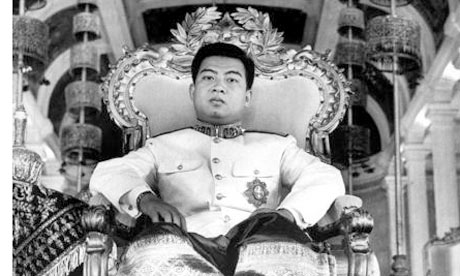
Prince Sihanouk - Cancer Survival, Cambodian National Symbol and Controversial Alliances

Following the publication of the first blog entry, Prince Sihanouk has  passed away peacefully on 15 Oct 212 at the age of 89.  The current Cambodian monarchy has lost much of its former glory and influence to the elected government headed by a ruthless, repressive and powerful Prime Minister Hun Sen. 


* * * 

Prince Sihanouk may be frail, but he has survived cancer and diabetes for three decades. He is a VIP of Chinese hosts who were instrumental in ensuring he enjoyed both quantity and quality of life. 


Most diagnosed with the C illness believed their days are numbered. But it is amazing that Prince Sihanouk managed to live another three decades despite having the terminal illness since the 1980s. The latest removal of a prostate tumour is the third or fourth bout of cancer Sihanouk has endured. 

http://www.independent.co.uk/news/world/sihanouk-has-tumour-removed-1510413.html

Even the most ardent supporter of TCM would not claim that there is a miracle cure, but it certainly would convinced many that there is hope and proven efficacy of TCM.  If patients maintain a positive thinking and perseverance, more will have success in winning over the battle over illnesses. Regular and continued checkup and treatment would be necessary to keep relapse of cancerous growth at bay. 

Has Sihanouk lived a fruitful life with borrowed time extended? He is widely respected by Cambodians, and many leaders in Southeast Asia. He has been pivotal in cobbling a peace settlement that ended the war in Cambodia. 

Nevertheless, like any leader, Sihanouk has been criticised for his controversial decisions.  He was condemned by some for a marriage of convenience with the genocidal Khmer Rouge. This is in spite of the fact that the alliance included non-communist resistance groups in the fight against Vietnamese invasion and occupation of Cambodia with Soviet backing. 

The circumstances are more complex and difficult for any leader to choose between the lesser of the two evils. In fact, some argue that the US bombings and subsequent withdrawal from Vietnam spurred the rise of the radical Khmer Rouge. Certainly, Sihanouk was forced to walk the tight rope, performing a dangerous balancing act. Members of royalty had been victims of genocidal elimination, and Sihanouk himself was at risk of being killed too.  

http://wn.com/Norodom_Sihanouk

http://www.huffingtonpost.com/sharon-wu/press-coverage-of-the-cam_b_1469187.html

Naturally, the Khmer Rouge was solely responsible for systematic murder. However, many scholars, including Noam Chomsky, very publicly criticized the U.S. for contributing to the genocide as well. These scholars published long editorials regarding the issue of responsibility.
Firstly, they believed the U.S. played a large role in creating the political atmosphere from which the Khmer Rouge grew. Due to U.S. bombing and Lon Nol's inefficacy, Cambodians suffered immensely in a dysfunctional society. Their growing frustration drove them to support the Khmer Rouge, who promised to help the nation recuperate.
Secondly, the U.S. was strongly criticized for the extensive bombing, which destroyed vital resources. Critics of American foreign policy blamed the U.S. for the deaths related to disease and starvation. Even if the Khmer Rouge had not taken over, these deaths still would have occurred due to destruction.
In defense of all the people who stood by without taking action, one could ask, "What could we have realistically accomplished?" After Vietnam, no one in the U.S. wanted to see troops in Cambodia. It was an enormously complicated situation that couldn't easily be resolved simply with money or soldiers. Stopping the Khmer Rouge was one thing; rescuing the Cambodian population was another. Cambodia was burdened with a decade of fighting, corruption, famine, and murder. Saving Cambodia would mean a complete reformation of Cambodia's society, government and economy. There were no simple solutions.


Sunday, April 22, 2012

Anthony Salim : Asian billionaires beneficiaries of political cronyism


Anthony Salim is fortunate to be born with a silver spoon in his mouth. The actual worth of his father Liem Sioe Liong is said to match the world's richest men. Political fortunes may rise and fall and personalities who received patronage lose popularity according to the times. However, the Liem (Salim) family appears to have survived the turmoil of uprisings, racism and economic crises. Indeed, savvy players never fade away. 

A few ultra rich Indonesian Chinese will give ethnic minorities a bad name, and the impression that all are wealthy, exploitative and oppressive against the native Indonesians. The reality is that most Indonesian Chinese belong middle class with some even in the lower income groups. They bear the brunt of attacks when things go wrong. They also struggle to build up what little they have that can vanish with every policy or regime change. 


http://www.asianewsnet.net/home/news.php?id=26886&sec=1

Quote :

Forbes magazine’s 2011 list of Indonesia’s richest people placed the leader of the Salim Group at fifth place, with a net worth of US$3.6 billion.

Anthony’s ranking in the Forbes’ lists over recent years has improved. In 2010, he was also in fifth place, higher than the ninth position he occupied in 2009. In 2008, Forbes put him at 11th position.
Anthony is the son of Sudono Salim, also known as Liem Sioe Liong, the founder of the Salim Group, which now controls dozens of major businesses including the world’s largest instant-noodle maker, PT Indofood Sukses Makmur.

Sudono, widely-known for his close connections to the Soeharto family, turned over the management of the group to Anthony in 1992.

Anthony is believed to have shifted the way he approaches power since Soeharto’s fall in 1998, which brought a revolutionary change in Indonesia’s politics.

“The tycoons’ secret to survival was basically in line with the political shift. The tycoons, who used to be centralized under Soeharto’s patronage, are now liberated, in the sense that the tycoons are now more motivated to create their own political networks,” political analyst Fachry Ali told The Jakarta Post.

Before Soeharto’s New Order regime collapsed, major Chinese-descent tycoons were mostly “affiliated” with Cendana (the name of the street where Soeharto’s private residence was located) and enjoyed facilities such as easier procedures for obtaining permits and very low risk of being stung with legal problems.

“On the other hand, Soeharto’s family members also benefitted from the patronage; while Soeharto himself utilized the patronage to dominate the government, the parliament, as well as the police and military,” Hendardi from the Setara Institute told the Post.

The reform movement in 1998 brought the nation to euphoria with the ending of the Soeharto-era cronyism.
But many Chinese-Indonesian moguls, who enjoyed the “glorious” New Order years, did not disappear; they merely shifted their “methods” in influencing power, Fachry said.

“Their capital posed significant attractions to political groups, which have become increasingly more diverse today. The richer a political party is, the greater its influence and ability to gain support,” Fachry said.
The Chinese-Indonesian couple Murdaya Widyawimarta Poo and Siti Hartati Tjakra Murdaya is a perfect example. After the fall of Soeharto, the tycoon couple entered the political arena.

Murdaya, who assumed 14th position on Forbes’ 2011 list, became an Indonesian Democratic Party of Struggle (PDI-P) lawmaker, while his wife joined Democratic Party.

Another example is Chinese-Indonesian tycoon Hary Tanoesudibjo, the owner of the media conglomerate, the MNC Group, who chairs the board of experts at the newly established Nasdem Party.

“In the past, Cendana was the only patron. Today, each of the moguls has become patron to the network established and controlled by the moguls,” Fachry said.

Although, he added, not all of the tycoons are eager to publicly disclose their political ties. “In most cases, they established their connections silently because the networks involved more than one political party,” he said.


Friday, March 16, 2012

Greg Smith : Goldman Sachs Toxic Culture -Conscience Conscious Insider Exposes Moral Deficit in High Banking Society

Most of us struggling just to make a living may quietly swallow our pride and integrity and accept nonsense from unconscionable bosses and organisations. Some have become partners in crime knowingly or unwillingly. 


Greg Smith prefers to step out of line to speak his mind with a heart. 


How we measure SUCCESS nowadays! 
Certainly not earning an honest living, provide good products and services, but driven purely by greed and profit?  Big businesses especially in banking and finance have "lost the moral fibre".  Reaping short term impressive gains prevail over public good, accountability to small shareholders and employee welfare.
Sadly, the GFC has not got rid of chief executive leeches. They are still lurking around steadfastly, gobbling small helpless consumers, taking huge fat salaries, only conjuring tricks in a more discreet manner. The immoral continue to dominate the financial and political scene. 
QUOTE : 
This week people have been buzzing about Goldman Sachs executive Greg Smith's high-profile resignation from Goldman and his description of the way that company's ethics and morals have declined over the last decade and more, especially under current CEO Lloyd Blankfein.
But Smith's revelations aren't really news at all, and the moral decline he describes at Goldman has been replicated throughout our corporate culture. Behavior at Wall Street firms like Goldman may have been more overtly criminal, but the shift from respect for the customer to the desire to rip customers off is pervasive and insidious.
Wall Street has, of course, been the epicenter of this behavior. Years ago it was reported that traders at Morgan Stanley used to get off a phone call and gleefully shout "I ripped his face off!" - about their own clients - after successfully selling them what they knew were garbage investments. The surprise isn't that Goldman Sachs encourages its employees to mislead clients and put its own interests above theirs - the surprise is that anybody is surprised.
We should know better.
Capitalism has always been based in part on predatory behavior. But a series of progressive reforms that began more than a century ago managed to bring the predators among us under control. Laws and regulations were a key part of that control, but a four-decade long conservative crusade against them has brought us to the point where Democratic Presidents can echo the anti-regulatory rhetoric of the right without fear of reprisal from their own base.
We need to restore the respect that regulations and those who enforce them have earned over their decades of service to the country. But there needs to be even greater change - cultural change - before we can stop the kind of behavior that Smith described in his editorial. We need to end the culture of predation and stigmatize the corrupt business leaders who are tearing our society down.
It's true that Blankfein's a particularly egregious example of the culture of predation. But there isn't an executive on Wall Street whose company hasn't done things he should be ashamed about - and shunned for. And many of them should be under criminal investigation right now. Instead they're attending plush fundraisers with leaders from both parties and whining to subservient journalists that today's coverage of them isn't universally congratulatory. These guys don't want reporters, they want praise-singers like the ones that flattered ancient princes - and more often than not they get them.
But the culture of predation goes way beyond Wall Street. It's all around us. Here's an example from my own corporate life: While I was working in the insurance and risk management area back in the 1990s, a group of us were sent to one of those offsite 'bonding' get-togethers that were so popular at the time.
As was the custom in those days, slightly hippie-ish baby boomers (usually ex-teachers or ex-social workers) were hired as 'facilitators' to get us 'thinking outside the box' (I used to say "I have ADD; I lost the box," but they made me attend anyway.) This typically involved 'team-building exercises' like making a house out of string while blindfolded.
(Yes, that was one of our exercises.)
In one of the sessions we were encouraged to come up with an innovative idea for our own work area. To stimulate our 'creative juices,' we were given three examples from the real business world. One of them will be familiar to any man who shaves: Our granola-eating facilitators enthusiastically told us how the Gillette company managed to send its revenues sky-high by selling their razors at a low cost and then charging an arm and a leg for the blades. Gillette constantly changes its razor design so that lower-cost competitors can't sell blades to its customers.
Millions of American men have contemplated spending the rest of their lives looking like ZZ Top, just because of the Gillette company. Gillette has a stranglehold on the razor market and uses it to shaft its customers any chance it gets. The sleazy, anti-consumer Gillette strategy has even been adapted by formerly decent companies like Hewlett-Packard, who under prominent Republican Carly Fiorina because selling cheap and unreliable printers whose cartridges constantly run out of ink and cost a fortune to replace.
In Corporate America, however, that's not called sleazy behavior. It's called "thinking outside the box."
The second example was that of a public telephone company in some Midwestern city that decided it could make more money by making it unpleasant to use its pay phones. So, as our Birkenstock-wearing guides told us gleefully, some young executive suggested putting a heavy weight in the receiver and slanting the shelf underneath the phones so that you couldn't put anything there without having it fall off. Pretty soon they were all doing it. (Now pay phones are a thing of the past. It's like they say: Karma is a bitch.)
I forget the third "innovation," but it was equally repellent. But what I do remember is that only two or three of us in the group exchanged looks of disgust. A few other people were as excited as the group leaders, and the rest didn't care one way or the other.
What's the point of bringing this up? That the bond between business leaders and customers has been broken, and that businesses aren't being punished for it. They're not being punished by loss of customers or social disapproval, and when they break the law they're not being punished with jail time.
People have come to expect that the businesses which are supposed to serve them will do everything in their power to rip them off instead - and that nobody inside or outside of government will do anything about it. When people buy shoddy products and call the manufacturer for help they've come to expect endless wait times, followed by soul-killing robotic interactions with underpaid script-driven hirelings. When they open their bank or credit card bills they expect to be slammed with unadvertised and unaffordable add-on charges.
And they're rarely disappointed.
The Democrats' attempts to change this culture have been tepid at best (with the possible exception of the Consumer Financial Protection Bureau, which will only be as good as its Presidentially-appointed director). But even those tentative steps have been met with a firestorm of reaction, which too often is met with offers to water the reforms down even more.
What can be done? For one thing, computer owners can boycott companies like Hewlett-Packard, too. And we can explain why. For another, the men of America can boycott companies like Gillette. If we all wind up looking Amish it'll be worth the effort. Because you know what? The Amish are scrupulously fair and honest in their business dealings.
You can't say that about bank executives like Lloyd Blankfein at Goldman Sachs, or any of the other CEOs on Wall Street. And you can't say that about most other corporate CEOs these days, either. Sure, there are notable and admirable exceptions. But we need a movement to clean up our entire corporate culture. Maybe we could call it "Beards, Not Banks." And along with it, we need to restore our nation's respect for the laws and regulations that protect us from bandits, rascals, and thieves - and for the people who enforce those laws.
As long as we reward bad behavior with our money and our respect, things will only continue to get worse.

http://www.huffingtonpost.com/rj-eskow/culture-of-predation-that_b_1352718.html


Why Greg Smith Quit?


http://www.dailymail.co.uk/news/article-2115352/Greg-Smith-Goldman-Sachs-sees-2bn-wiped-market-value-trader-attacks-firms-toxic-culture.html 


http://www.nydailynews.com/new-york/goldman-sachs-exec-greg-smith-blasts-bank-op-ed-called-clients-muppets-bank-lost-moral-fiber-article-1.1038682

Tuesday, February 14, 2012

Osama Bin Laden - terrorist repentant? tells children not follow jihad

A terrorist who did not bat an eye at the deaths of innocent people finally saw light?

That is if you believe wholesale the words of Osama bin Laden's brother-in-law.

In an interview with a western media, Zakaria Al-Sada claimed that Osama urged his children to get a good education (modern secular?) in the West and refrain from the extremism and religious war path he followed. (paraphrased on condition that meanings are not hidden or lost in translation)

The immediate and superficial impact of resignation would be a blow to Islamist jihadists morale and propaganda to recruit new suicide bombers and warriors.  Is this a tactical retreat for longer term recoup and consolidation.

Conspiracy theorists and sceptics, however, believe that sending fundamentalist kids to the West and receive modern education would raise their stature and allow them to blend in with the crowd, cultivate and breed local-born to join jihad.

Is this really a deception spread by Osama's brother-in-law to impress upon the West not to be too hard on Osama's wives, children and grandchildren. Soothing words - what we love to hear rather than the hard truths - would coax target countries and innocent victims to let our guards down.

Oh dear, the bitter lessons of complacence have taught us to become so disbelieving that we can't even trust anything at face value without suspecting others'  intentions!

http://www.telegraph.co.uk/news/worldnews/al-qaeda/9077505/Osama-bin-Ladens-told-his-children-not-to-follow-him-down-path-of-jihad.html

http://www.ibtimes.com/articles/297889/20120213/osama-bin-laden-zakaria-al-sadah-pakistan.htm

http://my.telegraph.co.uk/cheechdog/cheech/15953283/osama-bin-ladendo-not-follow-me-down-the-road-to-jihad/


Would you trust the words of this neat young cool looking guy who is Osama's brother-in-law?

Wednesday, February 1, 2012

Warren Buffet's Religious Affiliation and Economic / Social Principles

Almost half of the billionaires in the USA are Jews. But Warren Buffet, the world's second richest man, is strictly not a Jew (religion).  He claims to be agnostic though he has many Jewish friends and business associates and has invested in Israeli companies.

 http://www.jewishjournal.com/nation/article/warren_buffetts_jewish_connection_20060602/

Unlike many influential Jews in Hollywood who had manipulated the media to condemn countries which could challenge Israel and US dominance in the Middle East and Africa, Buffet has been neutral and pragmatic.

On the contrary, Buffet has demonstrated lots of strategic patience (as opposed to rash reaction) and generosity towards social equality and redistribution of wealth.

Not one to flaunt his wealth, Buffet continues to live in the same five bedroom house in Ohama, Nebraska, for many year although he has more recently invested in a Californian beach house for chill out.


Buffet may be too old to learn foreign languages, but his friendly gesture on the eve of the Lunar New Year is well received by Chinese and Asian audiences. The guru's next investment destination?


China is no stranger to Buffett. He is venerated among China's wealthy as a "model investor," according to the AFP. Likewise, Buffett is no stranger to China—he's been positive about the country's growth in the past and has a nearly 10% investment in Chinese auto company BYD.

Read more: http://articles.businessinsider.com/2012-01-05/wall_street/30592195_1_warren-buffett-china-byd#ixzz1lByQYpiA

Rethink of lese majeste :reform proposal divides Thais with divergent interests - wither the King?

Is the monarchy a dinosaur in a modern democracy?

Even the divine status of the Thai King seems to be facing serious challenges. Until today, criticising the King was unthinkable. While the King had been a stabilising force in the days when military coups, protests and security threats were rife, it may no longer be necessary as the country reaches a higher level of economic and political development. Ousted PM Thaksin had tried to weaken the monarchy who is heavily influenced by ex-military chiefs but had cost him dearly. Lese majeste criminal code has been used against foreign visitors who showed disrespect to the monarchy, symbolic or ideological.

The red and yellow shirts have receded when the floods inundated Bangkok. The most hotly debated issue now is to challenge the code which teflons the from threats and insults, and virtually above the law.


Democracy demands debate on lese majeste law

    Bangkok Post  1 Feb 2012
Section 112 defines lese majeste as the defaming, insulting or threatening of the King, Queen, Heir-apparent or Regent. The maximum punishment is 15 years in jail for each offence.


http://www.bbc.co.uk/news/world-asia-16805096

Reform of S 112 is more pressing now than ever as the successor to the ailing King Bhumipol is his only son, Crown Prince Vajiralongkorn, a well known playboy and spoilt brat who has not earned the people's respect.  There is every chance that the next King is not wise and temperamental, hence he could be easily manipulated by both sides. The Crown Prince has been cultivated by the Thaksin camp as well. S 112 may serve as a useful tool for the older generation of power brokers.

Interestingly, the revered Thai King has ever remarked that he is not above the law. However, the Thai establishment prefers to be deaf to such hints. Indeed, ultra-royalists whose power and wealth rests on the unquestionable position of the King and the monarchy as a divine institution, have been the most stake in ensuring continued protection of lese majeste laws. In this latest agitation by academics and intellectuals, conservative oligarchs have again accused reformists of being proxies of Thaksin. The Thai government headed by Thaksin's younger sister Yingluck Shinawatra has been keeping mum for fear of threats. Protectors of the monarchy are powerful forces that continue to dominate Thai politics albeit from behind the scenes and above politicking.

http://asiapacific.anu.edu.au/newmandala/category/thailand/lese-majeste-thailand/

There is an age-old Thai belief which prophecised the demise of the Chakri Dynasty with the passing of King Bhumiphol (Rama IX). Perhaps these are early signs of what is to come. Stay tuned.


Saturday, January 28, 2012

Has Singapore PM Lee Hsien Loong come of age? Confidence, Maturity, Humanity and Humour

Lee Hsien Loong has projected himself and Singapore's image well at an interview with CNN during his attendance of the World Economic Forum in Davos, Switzerland.

The PM of Singapore has shown humility by making the unprecedented move to reduce Ministerial salaries, thought to be an unthinkable concession in the past.

He has treated tricky questions on international relations, income disparty and his personal / family succession issues in a diplomatic and relaxed manner.

It is often said that the best time for a leader to retire is when he is at his best and not to overstay his welcome and become a nuisance. However, at this point in time, it appears that no one has developed the calibre and charisma to win the hearts of Singapore voters to place their confidence in a post-Lee successor.